

NICOLE GOMEZ FISHER ON DIRECTING WITH HEART, HUMOR, AND TRUTH

From stand-up stages to award-winning films, Nicole Gomez Fisher crafts stories that honor complexity, contradiction, and humanity. Her work gives overlooked characters interiority, humor, and grace, letting emotional truth emerge without hurry or compromise.

“FOR MUCH OF MY LIFE, I WAS SO FOCUSED ON OTHER PEOPLE’S OPINIONS THAT I LOST SIGHT OF MY OWN VOICE.”
NICOLE GOMEZ FISHER, DIRECTOR
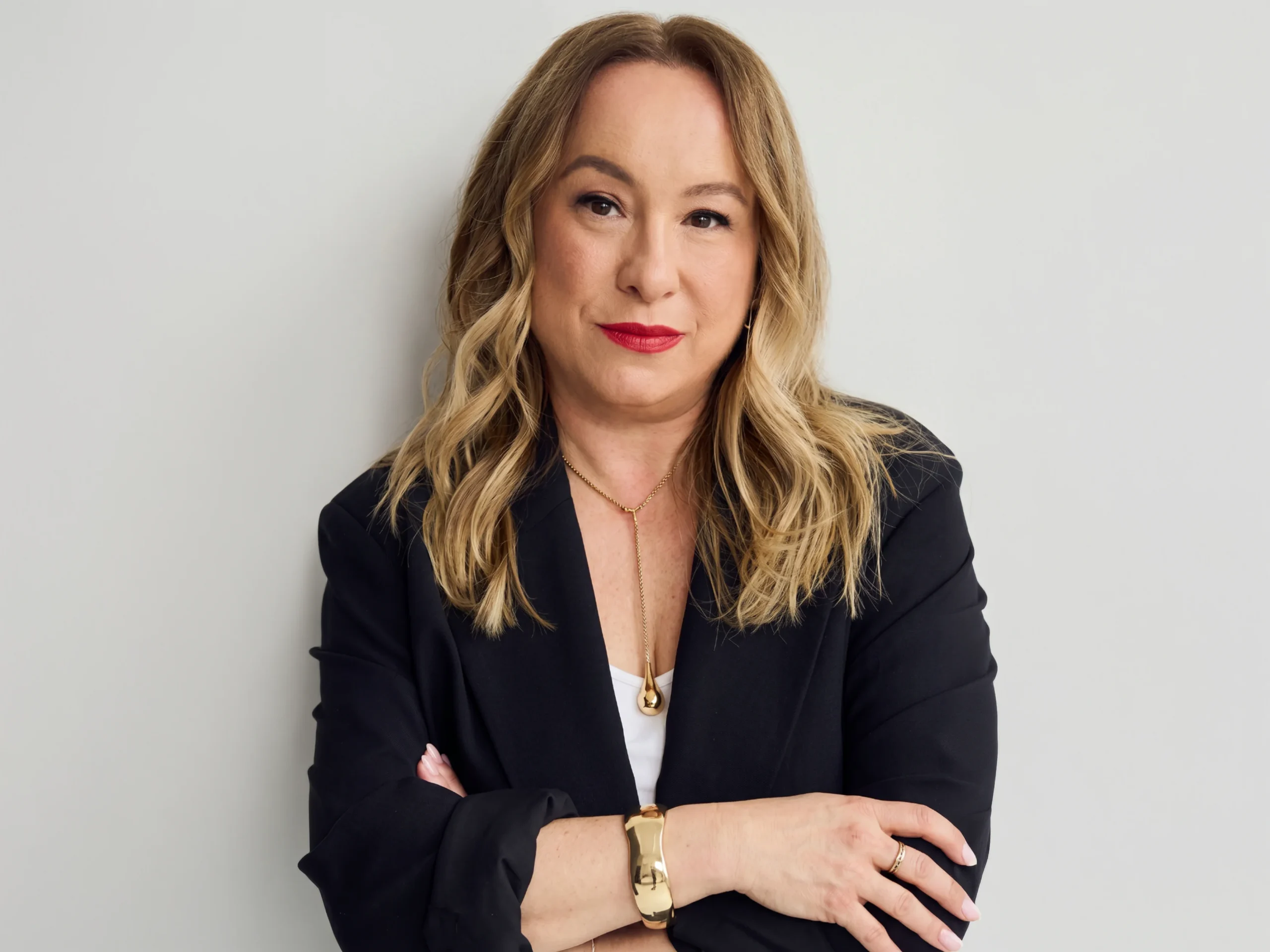
Nicole Gomez Fisher learned how to direct long before she ever stood behind a camera. She learned it by paying attention to people, to timing, to what’s said and what’s withheld. Long before she was calling “action,” she was listening closely to how people speak when they’re trying to be brave, how humor becomes a survival skill, and how stories carry the weight of family, culture, and contradiction all at once.
Her path into filmmaking wasn’t linear or sanitized. She came up through stand-up comedy and one-woman shows, including Mixed, which played the New York Underground Comedy Festival, and as a founding member of The Hot Tamales Live!—The Latina comedy tour produced by Eva Longoria and Kiki Melendez. Those early rooms, where timing mattered, and truth landed hard, still echo through her work. You can feel it in the way her films hold humor and heartbreak in the same frame, in the way her characters feel specific rather than symbolic. She tells stories that know where they come from.
As a director, Nicole has built a body of work centered on people who are often. overlooked or flattened elsewhere—women navigating love, family, ambition, and identity without neat resolutions. Her debut feature, Sleeping With the Fishes, starring Gina Rodriguez and Ana Ortiz, earned her the Best Director Award at the IMAGEN Awards, founded by Norman Lear. She carried that sensibility forward into Good Egg, with Yara Martinez, Andrea Londo, and Priscilla Lopez, and most recently into Hurricane Seasons, a family dramedy featuring Justina Machado, Aida Rodriguez, and Priscilla Lopez. Across each project, she gravitates toward stories that honor complexity. Her films don’t rush emotional payoff. They let characters be contradictory, resilient, and deeply human.
What distinguishes Nicole’s work isn’t just skill, but the point of view she protects. She understands that representation isn’t about placing bodies on screen; it’s about who gets interiority, who gets humor, who gets grace. Her collaborations reflect a quiet trust—performers returning to her work because she creates environments where truth can surface without force and vulnerability feels safe.
There’s a steadiness to the way Nicole moves through her career now—less urgency, more authorship. She has lived enough life to know that creative power doesn’t come from volume, but from clarity. From trusting your voice even when it doesn’t fit an existing lane. From building work that feels rooted rather than reactive.
Nicole Gomez Fisher is a storyteller shaped by comedy, culture, and care. And the stories she chooses to tell reveal a woman who understands that filmmaking, at its best, is not about control— it’s about listening closely enough to let something true emerge.
“THE MORE COMFORTABLE I’VE BECOME WITH NOT NEEDING POWER, THE MORE EFFECTIVE I’VE BECOME AS A LEADER.”
When you strip away roles, expectations, and outside pressure, what feels most true about who you are and how do you know when your work is aligned with who you’re becoming, not just who you’ve been?
What’s most true about who I am right now is that I trust myself. I make decisions with confidence, and I no longer spend my energy second-guessing them. I trust my instincts and move forward with conviction. And I know my work is aligned when I can tune out the distractions and focus entirely on the story and the emotional journeys of my characters.
When doubt or pressure shows up, how do you stay connected to your purpose, and where do you tend to listen first when making creative decisions?
I stay centered under pressure by stepping outside the noise, connecting with friends who have nothing to do with the business, and spending time with my daughters. Watching them grow has a way of putting everything into perspective. A glass of wine along the way doesn’t hurt, either.
Your journey began in stand-up and solo performance, where timing and truth are unforgiving. How did those experiences teach you to listen—both to yourself and to others?
There’s a saying that the smartest person in the room is often the quietest, and I’ve come to believe that wholeheartedly. It took me a long time to learn because, by nature, I like to talk. Ironically, it was doing stand-up comedy that taught me the value of listening. The space between the jokes, shaped by the audience’s reaction or sometimes their silence, teaches you everything about timing, awareness, and paying attention. For much of my life, I was so focused on other people’s opinions that I lost sight of my own voice. I let outside perspectives weigh on me more than they should have, and at times, I felt buried by them. That’s no longer the case. Today, I trust myself and my instincts. I listen more closely to my own judgment and spend less energy worrying about the naysayers. In fact, I’ve learned that some of the most negative people can become unexpected sources of motivation. Their doubt doesn’t hold me back. If anything, it pushes me forward.
Many of your characters navigate love, family, and ambition without neat answers. How do you approach telling stories that allow contradiction and emotional truth to coexist?
My approach is simple: write what you know. I’m drawn to characters who feel grounded and authentic because they’re often the most compelling to watch. Real life is full of contradictions, and those contradictions are often where the deepest truths live. When I started in this business as an actress, one of the most valuable lessons I learned was to make choices that seemed to contradict what you thought a character would naturally do. Ironically, those unexpected choices often revealed something more honest and human. They exposed the layers beneath the surface and made the character far more interesting. That lesson has stayed with me as a writer and filmmaker. I’m always searching for the tension between who people appear to be and who they truly are, because that’s where the most meaningful stories emerge.
You’ve worked with performers across generations and backgrounds. What do great actors need most from a director to feel safe enough to take risks and be truthful?
For me, the work has to come first. Actors need to believe in the material before they can believe in me. If they aren’t connected to the story or their character, no amount of reassurance or support from a director will produce the results anyone is hoping for. One of the things I enjoy most is working one-on-one with actors and collaborating on the development of their characters. Unfortunately, the realities of independent filmmaking often make that difficult. Limited budgets and tight schedules don’t always allow for the luxury of extensive rehearsals, table reads, or character workshops. That’s why clear communication is so important. Every actor processes direction differently. Some want to talk through a scene and explore the emotional nuances, while others prefer a single word or concise note that immediately unlocks the moment. Directing actors is a balancing act. It requires adaptability, active listening, and a willingness to remain open to their ideas. The best performances often come from that collaboration, where trust, preparation, and discovery meet.
Have there been actors you’ve worked with who taught you something unexpected about trust, vulnerability, or truth—and did that shift how you show up as a director?
Absolutely! One of the earliest lessons I learned is that not everyone in this business is your friend and that, at the end of the day, it is a business. Everyone wants to succeed, and if someone perceives you or your project as weak or believes they’re doing you a favor by being involved, it can create a dynamic where rumors and narratives begin to take on a life of their own, regardless of the quality of the work. The more visible you become, the more that dynamic can be amplified. People are often quick to believe what they hear rather than take the time to seek out the truth. Early on, that affected me more than I’d like to admit. Now, I focus my energy on the things I can control: the work, my integrity, and staying true to myself. Ironically, for an industry built on storytelling and emotional truth, it is also fueled by insecurity, ambition, and ego. There’s a contradiction in that which I find fascinating. But it’s a reminder that while perceptions may shift and opinions may change, the work itself is what ultimately matters.
“YOU CAN’T RUSH GROWTH, RELATIONSHIPS, OR STORYTELLING. THEY UNFOLD IN THEIR OWN TIME.”
People talk a lot about representation as being seen. Your work seems more interested in being felt than in being seen. What does true representation mean to you when it comes to honoring a character’s inner life?
To me, true representation begins with honoring a character’s humanity before anything else. It’s about understanding not just who they are on the surface, but what they want, what they fear, what they hide, and what contradictions they carry within them. The goal is never to reduce a character to a label, identity, or circumstance. It’s to portray them as a fully realized person whose experiences feel honest and specific. I’m drawn to the idea that the more specific a character becomes, the more universal they feel. Real people are complicated. They can be strong and vulnerable, generous and selfish, confident and insecure, sometimes all within the same moment. Honoring a character’s inner life means embracing those contradictions rather than smoothing them over. As a filmmaker, I try to approach every character with curiosity instead of judgment. I want to understand why they make the choices they do, even when those choices are flawed. When audiences recognize a piece of themselves in a character, regardless of background or circumstance, that’s when representation feels authentic. It’s not about creating perfect characters. It’s about creating truthful ones.
Having lived inside comedy, acting, and directing, how has your relationship to power changed as your voice has clarified?
Having worked in comedy, acting, and directing, my relationship to power has changed dramatically over time. Early in my career, I often viewed power as something external, something that could be granted or taken away by other people. I spent a lot of energy seeking validation, approval, and permission, believing that if the right person believed in me, it would somehow legitimize my voice. As my voice has become clearer, I’ve come to realize that real power comes from trusting myself. It comes from having the confidence to make decisions, stand behind them, and accept that not everyone will agree. The older I get, the less interested I am in convincing people and the more focused I am on the work itself. Comedy played a significant role in that evolution. Stand-up teaches you very quickly that audiences can’t be controlled. Some nights they laugh, some nights they don’t. What matters is your ability to stay present, listen, adapt, and remain authentic. Directing reinforced that lesson. Today, I think of power less as influence over others and more as clarity within myself. It’s the ability to trust my instincts, stay grounded in my values, and move forward regardless of outside noise. Ironically, the more comfortable I’ve become with not needing power, the more effective I’ve become as a leader.
There’s a steadiness in how you move through your career now, less urgency, more authorship. What did you have to unlearn to arrive there?
I had to unlearn the idea that every opportunity was the last opportunity. Early in my career, there was a sense of urgency attached to everything. Every meeting, every project, every relationship felt like it could determine the future. That mindset can be motivating, but it can also lead you to make decisions out of fear rather than conviction. I also had to unlearn the habit of measuring my success through other people’s opinions. For a long time, I gave too much weight to external validation and not enough to my own instincts. If someone praised the work, I felt confident. If they questioned it, I questioned myself. Over time, I realized that living that way was exhausting and ultimately unsustainable. What changed was learning to trust my own voice. Not because I think I have all the answers, but because I’ve spent enough years doing the work to recognize when something feels true. That trust has brought a sense of steadiness to my career. I’ve also learned that patience is not the same as passivity. Some of the most meaningful things in my life and career have taken years to develop. You can’t rush growth, relationships, or storytelling. They unfold in their own time. These days, I feel less urgency and more ownership. I’m focused on telling stories that matter to me, collaborating with people I respect, and trusting that the work will find its audience when it’s ready.
When you imagine the life you’re building beyond any single project, what feels most important for you to honor or protect?
More than anything, I want to protect the things that keep me connected to who I am outside of the work. Filmmaking can be all-consuming. Projects come and go, successes fade, disappointments pass, but the people you share your life with are what remain. My family is at the center of that. Watching my daughters grow, being present for the moments that can never be recreated, and nurturing the relationships that matter most are far more important to me than any credit or accolade. The older I get, the more I understand that time is the one thing you can’t earn back. I also want to protect my sense of curiosity and my connection to storytelling. I never want the business side of this industry to overshadow the reason I fell in love with it in the first place. The goal has never been simply to make films. It has been to tell stories that explore what it means to be human and to create work that resonates with people on an emotional level. Most importantly, I want to protect my authenticity. There’s a lot of pressure in this industry to chase trends, seek approval, or define success through external measures. What matters to me now is staying true to my instincts, my values, and the stories I genuinely feel compelled to tell. When I think about the life I’m building, I hope it’s one defined not by the number of projects I completed, but by the quality of the relationships I cultivated, the experiences I shared, and the integrity with which I approached both my work and my life.
For a woman learning to trust her voice, even when it doesn’t fit an existing lane, what would you want her to know about listening closely enough to let something true emerge?
I would tell her that her voice doesn’t need permission to exist. One of the hardest lessons to learn, especially in a creative field, is that if you spend too much time trying to fit into an existing lane, you can lose sight of what makes your perspective unique in the first place. I would also remind her that not fitting into an existing lane can be a gift. Learning to trust your voice means paying attention to your instincts, even when they don’t align with other people’s expectations. Some of the most meaningful work comes from people who stop trying to belong and start paying attention to what only they can say. The goal isn’t to be different for the sake of being different. It’s to be honest. And honesty has a way of finding its audience.