
THE BODY REMEMBERS: JEWELIANNA RAMOS-ORTIZ
ON ENDURANCE

Stunt performer Jewelianna Ramos-Ortiz reflects on endurance, recovery, and the quiet discipline required to build a life designed to last.
PHOTOGRAPHY BY ALEXANDRA ZAK
HAIR AND MAKEUP BY BRITTANY FISHMAN

“I’VE LEARNED THAT YOU CAN’T FAKE PEACE. YOU EITHER DID THE WORK OR YOU DIDN’T.”
JEWELIANNA RAMOS-ORTIZ, STUNT PERFORMER
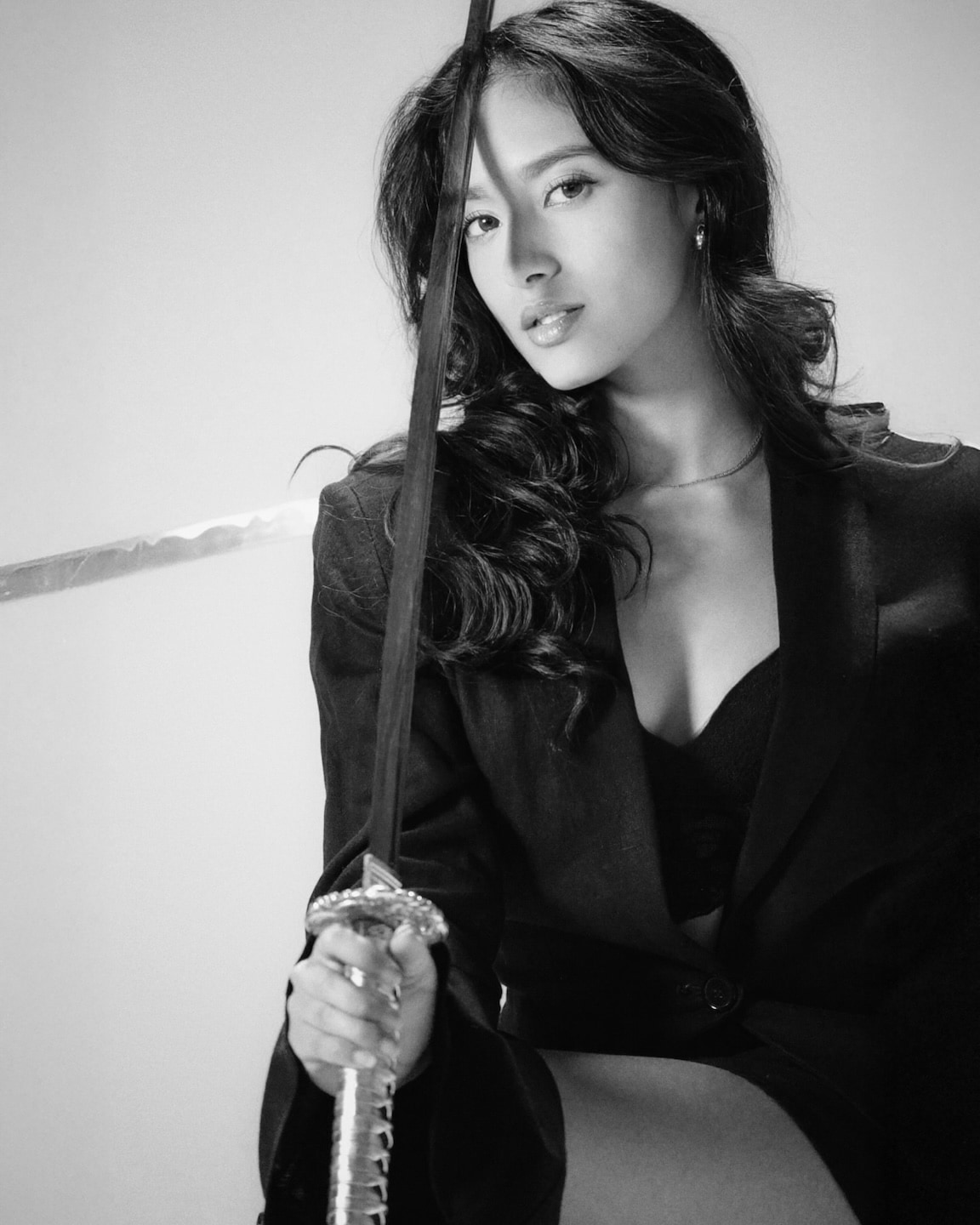
PHOTOGRAPHY BY ALEXANDRA ZAK
There is a particular stillness that exists just before movement, a quiet calibration between breath and muscle, instinct and intention. During the Super Bowl halftime show, suspended high above the field and gripping metal engineered to resemble utility poles, Jewelianna Ramos-Ortiz felt that stillness settle in.
The stadium was electric. Lights fractured across steel. Tens of millions watched from living rooms and crowded bars, phones lifted, history unfolding in real time. But in the air, spectacle narrows, and what remains is structure: grip, timing, and trust.
Her forearms burned long before the music reached its crescendo. Chalk dust pressed into the lines of her palms. The rigging vibrated faintly beneath her weight. The choreography required aerial control, strength, and steady breath, leaving almost no margin for error. In those moments, her body carried both the movement and its consequence. Not dramatic or defiant, but precise. In that aerial sequence, she was the only woman suspended above the field, a distinction that carried weight long before it reached headlines.
By morning, that detail would travel quickly. For Jewelianna, its meaning began elsewhere, years earlier, on training floors where discipline was inherited rather than chosen, inside studios run by her parents and uncles in Bayamón, Puerto Rico.
Martial arts was not an after-school activity. It shaped the atmosphere of her childhood. It became a language of its own. Forms were practiced before homework. Balance was corrected before posture. Breath sharpened before voice.
At thirteen, she claimed her first world title not as spectacle, but as evidence of repetition.
That repetition would later become something far more vital. After a car accident threatened her ability to walk, the same foundations that once built strength became tools for restoration. Martial arts was no longer a performance. It became a reclamation, the slow re-education of muscle, the quiet insistence that the body could remember how to stand even when fear lingered longer than pain.
Recovery did not arrive as triumph. It arrived in increments, a foot steady where it once trembled, a step taken without hesitation, doubt quieted by returning to the basics. In that slow rebuilding, her understanding of power shifted. Strength was no longer about dominance or speed, but about staying, endurance, stewardship, and the discipline to continue.
Hollywood came later. So did stunt work. So did doubling for some of the industry’s most recognizable faces. The job demands invisibility, a performer acting through impact rather than dialogue, embodying another woman’s physicality so seamlessly that audiences never notice the substitution. It requires ego to dissolve without identity dissolving alongside it—control without hardness, precision without spectacle.
In an industry that rewards intensity, she studies endurance. Recovery is not an afterthought; it is architecture. Ice baths are deliberate, not dramatic. Stretching continues long after rehearsal ends. Quiet mornings before call time create space for recalibration. The discipline that once trained her to strike now trains her to soften, to protect the nervous system that absorbs impact, to recognize fatigue before it becomes injury.
For her, sustainability is not aesthetic. It is survival. Partnership is woven into that structure. Among the performers suspended on those same poles during the halftime show was her husband, also a stunt professional, navigating the physics of risk. Sharing danger redefines ambition, making success less about applause and more about returning home intact. Conversations shift from career milestones to recovery strategies, and trust becomes concrete. The work remains individual, but the stewardship of the body and the life built around it is shared.
That may be the deeper story beneath the steel and spectacle, not simply that she was there. Not simply that she made history in the air. But that she has built a life designed to endure beyond a single broadcast. Suspended above a stadium, she did not perform for the moment alone. She moved with the understanding that careers built on impact require something quieter beneath them: care, discipline, humility, and the willingness to continue training long after the applause fades. In the conversation that follows, Jewelianna reflects on rebuilding after injury, sustaining love inside high-risk work, protecting the nervous system in a spectacle-driven industry, and defining strength on her own terms.
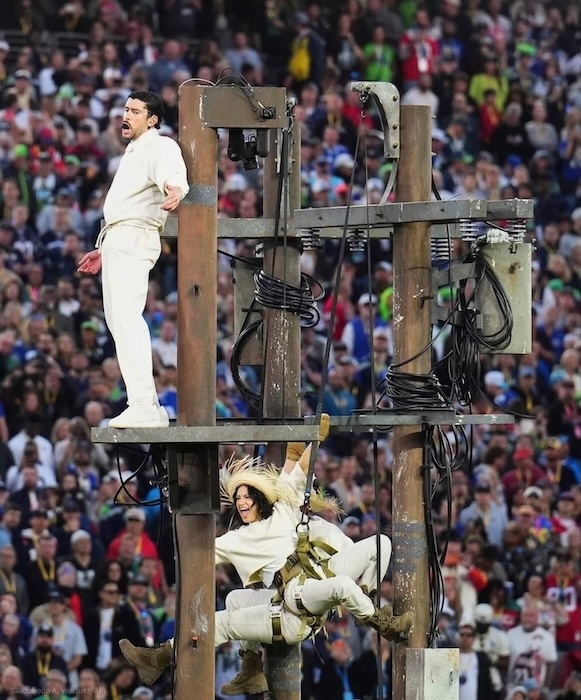
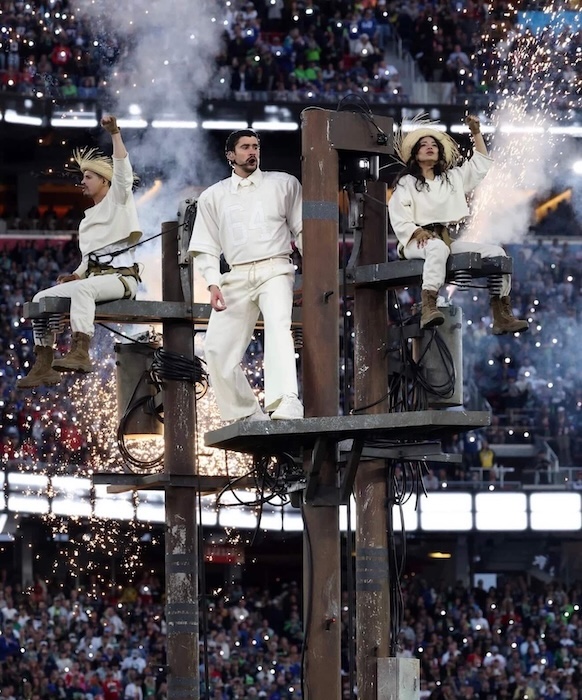
Jewelianna Ramos-Ortiz performs the stunt sequence during the Super Bowl halftime show alongside Bad Bunny, with stunt performer and husband Justin Ortiz on a neighboring pole.
“It probably looks calm from the outside, but inside, I’m checking in with myself, because I care so much about my craft. In that moment, it’s me, myself, and I having a team meeting, “okay, breathe, feet grounded, shoulders down.”
During the halftime performance, there’s that moment of stillness before you move. What’s happening inside you right then, physically or mentally, that allows you to stay steady?
That stillness is intentional, and it’s hard-earned. I’ve learned that you can’t fake peace. You either did the work or you didn’t. It probably looks calm from the outside, but inside, I’m checking in with myself, because I care so much about my craft. In that moment, it’s me, myself, and I having a team meeting, “okay, breathe, feet grounded, shoulders down.” Reviewing cues and movement with my eyes closed because my brain and body are synced. I’m not thinking about the crowd or what anyone expects. I’m just thinking about the first beat. The first move. So that stillness is really trust. I’ve rehearsed it so many times that it feels like second nature, something happens where I almost black out, and the performer in me takes over and knows exactly what to do and just does it.
After your accident, rebuilding required patience rather than force. How did that season change the way you relate to ambition and to yourself?
It meant that I was no longer comparing myself to anyone around me, and that turned into my real superpower. The energy around my ability to do anything became a celebration because a doctor once told me I wouldn’t be able to walk again. I rebuilt and wasn’t looking to see what anyone else was doing; it was just me and the confidence I was allowing myself to gain from every win, no matter how small. I was in my own lane, and I was writing my own narrative. Comparison is the thief of joy, and when I couldn’t compare, I was just having so much fun, and the universe responds to that energy. At some point, I could look back at how far I’ve come and use it as a track record for success that makes me want to shoot for more. “Well, I overcame that. I can do hard things, so that I can do this.”
You were raised in a family where discipline was simply part of the atmosphere. As an adult, which parts of that foundation have you chosen to carry forward, and which have you redefined on your own terms?
My parents came from very little in Puerto Rico and moved to Miami at 20 with an entrepreneurial dream of opening martial arts schools. Discipline is in my DNA. I carry it with me, whether I like it or not, haha. Even on my off days, I think about all the things I could be doing to reach for more. I can’t sit still; there is always a business idea or a skill I’d like to develop. If my body needs a break, I read; if my mind needs a break, I work out. I wake up every day excited about life, and I don’t need anyone breathing over my shoulder making sure I’m being productive because I prayed for this life, my parents dreamed of this life, how could I waste any bit of it? I wish I understood balance a little better. I struggle with allowing myself to rest at times; in fact, my parents often call me to make sure I’m taking time to rest and relax. But if I’m being perfectly candid, the truth is I’m just so excited about life. Even when the motivation disappears, I feel that discipline says, “1% better, you can do 1%,” and sometimes that 1% better is treating myself to a luxurious spa day, delicious food, and good company.
Stunt work asks you to step into someone else’s body again and again. How do you stay grounded in who you are when your job is to disappear into someone else?
Stepping into a character’s physicality on a film, TV show, video game, or live event, my identity doesn’t dissolve; it expands. I know who I am outside of the role. I train as Jewelianna. I recover as Jewelianna. The character is a layer, not a replacement. At the end of the day, we all have the same end goal: to tell that story. I break down the story, I study the character, I study my actress and how she portrays that character in the story, and then I get to do what I love most because the breakdown and preparation were there.
This industry can push people to go harder and faster. You seem to think long-term. When did you realize that longevity mattered more than intensity?
Longevity is found in the intensity for me. I intensely pursue multiple career paths, knowing that nothing is forever and I always have something else I love to do and I have worked hard to build. I can always pivot to these different outlets without missing a beat. I can’t be put in a box, and that is what longevity looks and feels like to me. One day, I won’t be able to hit the ground as hard as I do now, and that’s okay because I love to produce. Maybe I get burnt out from all the behind-the-camera logistics, well, good thing I love to act, or professional speaking, or stunt coordinating if I’m still missing the action. Longevity for me is taking time now, while I’m young and growing in as many ways as possible, so if life asks me to redirect, it happens with flow, not resistance.
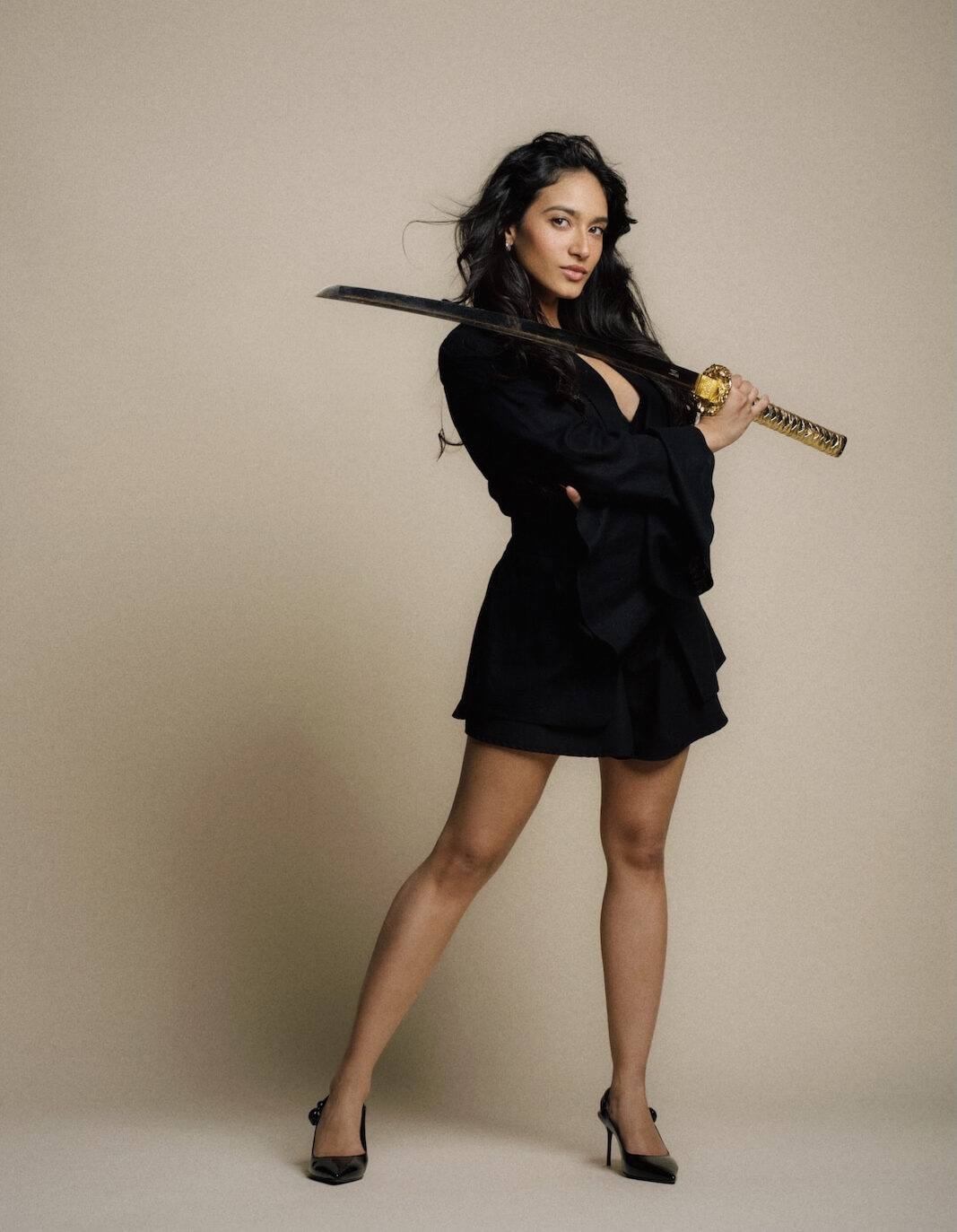
“I TRAIN
AS JEWELIANNA.
I RECOVER AS JEWELIANNA. THE CHARACTER IS A
LAYER, NOT A
REPLACEMENT.”
You’ve described recovery as something built into your life, not added on afterward. What does caring for your nervous system look like day to day?
Affirmations, good food, and a support system I can truly lean on—one for the mind, one for the body, and one for the soul. To be able to run this hard in such a tough industry that is always asking more of you, learning to pour into yourself is important. I love to journal. Sometimes self-doubt likes to rear its ugly head at you, but I keep a log of the things I’ve done. I use my social media as a public journal of all the things I get to do, so when I’m feeling pretty run down, I get to remind myself of all the amazing things I get to do and how much I have accomplished in such a short period of time. These are small things I can do anywhere and everywhere, even after long workdays or when I’m traveling, so I rarely miss a day. I can tell when I’ve been missing days and get back on track pretty easily to regulate my nervous system. If you create a system that works for you and sustainably build it into your life, it’s a game-changer.
Sharing a high-risk profession with your husband creates a rare kind of partnership. How has that shaped the way you think about success and coming home whole?
My husband and I really look at success as more than booking the job; it’s coming home safely, it’s creating impact, inspiring the next generation, having stories worth telling, and being able to tell them yourself, not in a memoir. We know it is such a privilege to run and play with our dogs, snuggle, and play video games together. We understand the risks without having to explain them. Or even if we do want to explain them, having a partner that truly understands is priceless. There’s an indescribable amount of respect for each other. We know how to step in and help carry the load at home or in our business, while the other is mentally and physically fully present on set, making sure they enjoy the work and get to come home to enjoy life outside of the work. No complaints, just an understanding that this is the beauty of partnership.
Your strength is visible on screen, but it also requires restraint. Where does softness exist in your world?
Softness exists in my marriage. In my family. In my friends — when I’m at their house, lying on their couch for hours. Softness is when I dress up anytime I’m not gonna be at work. It’s letting my husband open doors for me even though I’m more than capable. It’s allowing myself to cry when I need to. It’s lying with my dogs listening to my vinyl collection in my library or on a luxurious vacation out of the country. Softness can be in the smallest details or the largest experiences; it never, not once, makes me doubt my strength.
When the lights come down, and there is no role to inhabit, who are you? What spaces or rituals return you to yourself?
The truth is, I work just as hard when no one is watching as when I am in the spotlight. I love to educate myself, I love to read, and I love to sit with nature and a delicious coffee. Journal my thoughts and feelings, finding clarity in the direction I’m going to run towards. I am a wife, a daughter, a friend. Something that is always at the top of my list is snuggles and playing Call of Duty with my husband and the dogs in our game room. Add playing online with my friends on FaceTime, and that is a perfect “off-day” for me. The other thing I can always count on is being in the ocean, something about telling the water about my fears, aspirations, doubts, and my dreams, it heals me. I feel whole again after spending time with Mother Water. And lastly, eating good food with my parents and spending a day on the boat reminds me I am everything younger me would have wanted to be and more.
As your career continues to expand, what kind of life, not just legacy, are you intentionally building?
A life I’m proud of. I think if 10-year-old me is proud and 80-year-old me doesn’t have a long list of “what if’s,” then I’m doing it right. I want to raise the standard for what women, especially Latina stunt performers, are seen as capable of. I’m building range. I’m building a body of work that speaks before I have to. Wreck Hard Productions. I’m very intentional about growth. I’m not just interested in participating in this industry; I want to shape it. In front of and behind the camera. As a stuntwoman, an actress, and a producer. Refusing to be put into a box. The life I’m building is intense. It’s disciplined. It’s unique, but it’s mine, and I wouldn’t change it for the world.