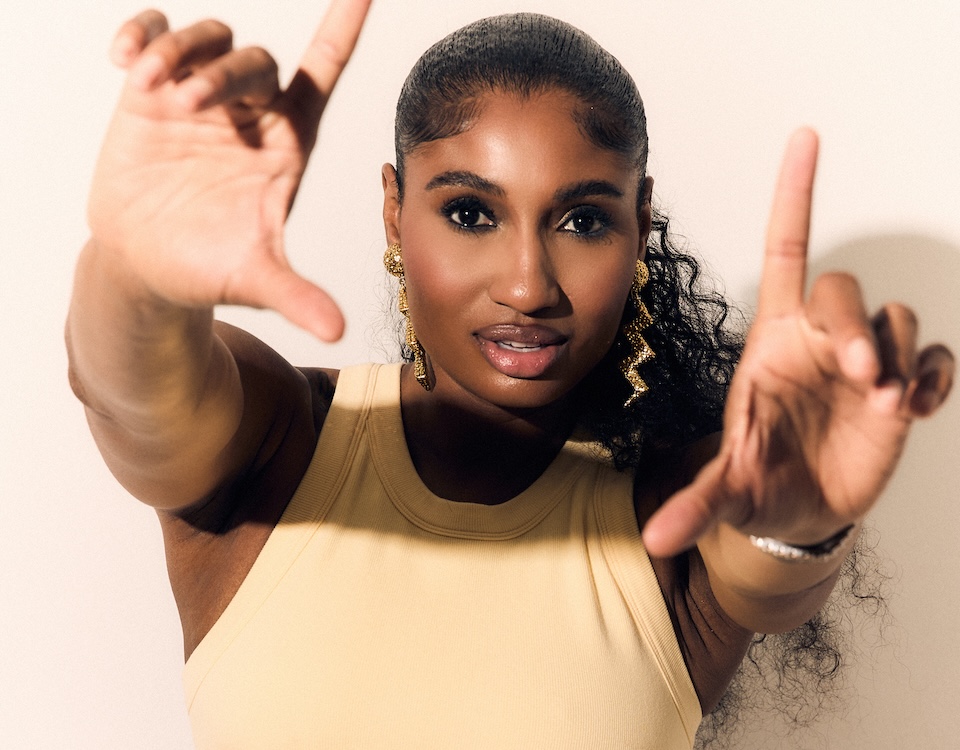
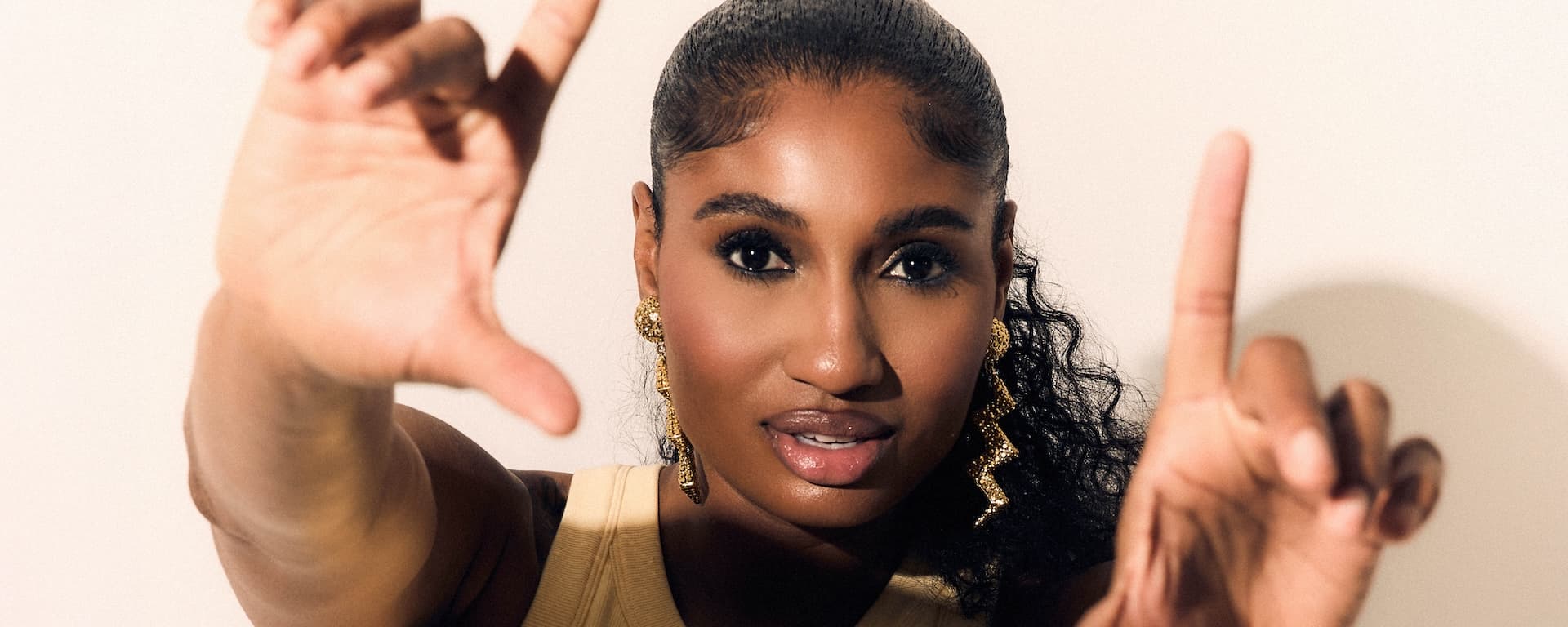
ANGEL MCCOUGHTRY BEYOND THE ARENA

From the WNBA to filmmaking, former WNBA star Angel McCoughtry reflects on life after the WNBA and her short film Bygones on Prime Video.
PHOTOGRAPHY BY TIMOTHY FERNANDEZ

“WAITING DOESN’T FEEL LIKE HESITATION; IT FEELS LIKE RESPECT FOR THE PROCESS.”
ANGEL MCCOUGHTRY, AMERICAN BASKETBALL PLAYER

PHOTOGRAPHY BY TIMOTHY FERNANDEZ
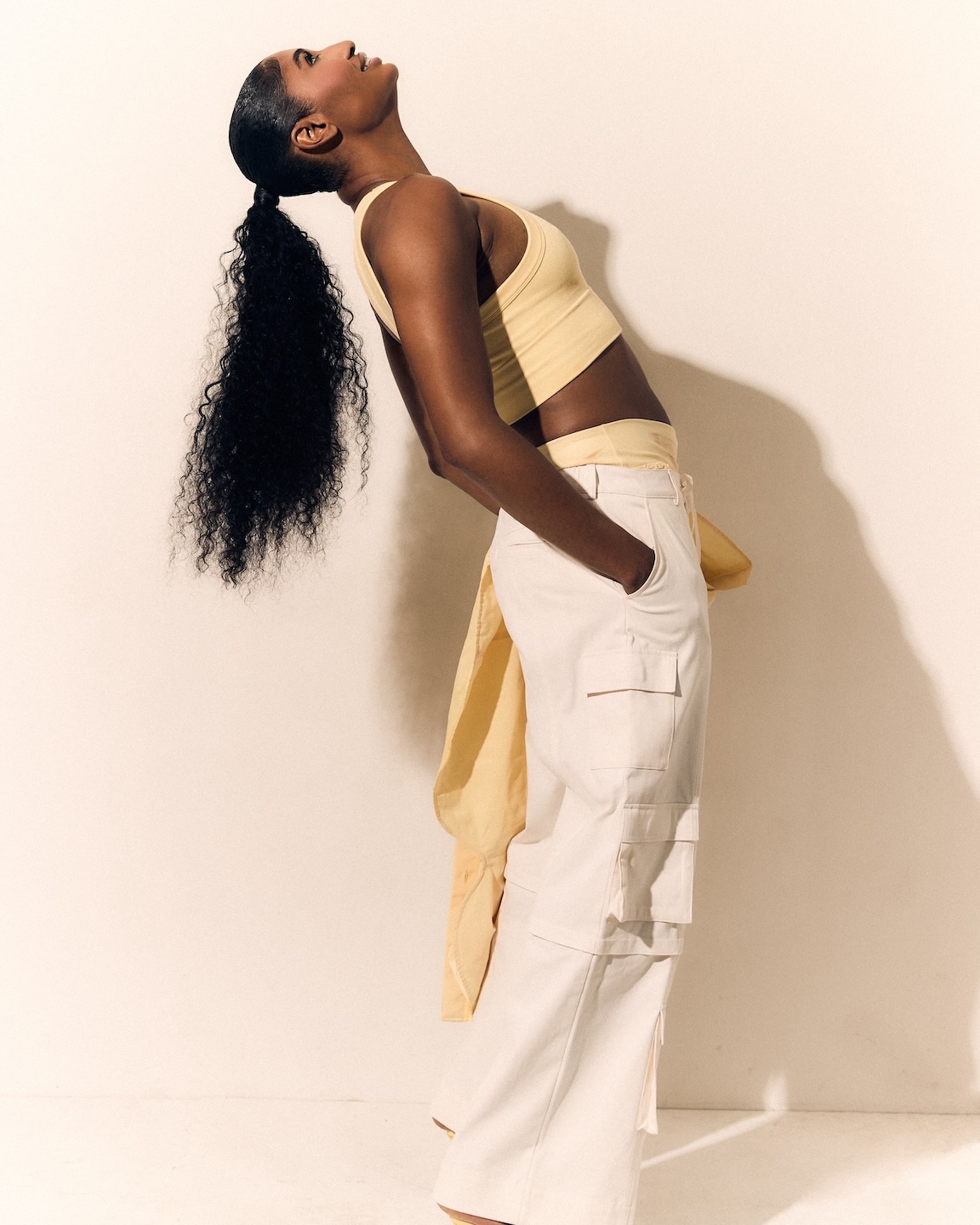
Angel McCoughtry doesn’t speak about pressure as something to overcome. It’s simply the environment she knows best. For most of her life, expectation wasn’t abstract—it had a clock, a crowd, a consequence. Watching her play, there was often the sense that she arrived early to the moment, already aware of what would be required of her. That awareness—sharpened over years, mostly rehearsed in silence—is what people tend to mistake for fearlessness. It’s something quieter than that. Attentiveness. A way of staying present while everything else accelerates.
Long before filmmaking entered the conversation, Angel had already lived a career defined by consequence. A former No. 1 overall draft pick, two-time Olympic gold medalist, and one of the most decorated players in WNBA history, she spent years carrying expectation not just for herself, but for teams, cities, and a league still fighting for visibility. Leadership, for her, was never theoretical. It was practiced nightly, under lights, with stakes that extended far beyond the scoreboard.
That quality hasn’t disappeared now that the arena has changed. If anything, it’s had more room to stretch. Angel’s entry into filmmaking doesn’t read as a career turn so much as a continuation of how she’s always moved through the world—observant, intuitive, alert to emotional shifts others pass over. She thinks in terms of timing, trust, and consequence—what happens if you wait a beat, what gets lost if you don’t, what people carry with them once the moment is over.
Bygones, her first short film under McCoughtry Entertainment, is now streaming on Prime Video and marked the beginning of this chapter—a quiet, confident exploration of memory, accountability, and emotional truth. It reflects an emerging cinematic voice that values restraint over spectacle, and meaning that arrives slowly, on its own terms.
Through McCoughtry Entertainment, Angel is building a body of work that extends across narrative, documentary, and socially conscious projects, from the WNBA docuseries We Are the W to stories rooted in place and community. There is a noticeable lack of urgency in how she explains herself. In conversation, she returns often to discipline—not as control, but as care: for collaborators, for audiences, for the integrity of the story itself. Her upcoming feature, Apt. 6B, continues that approach, signaling a move toward longer-form storytelling shaped by intention rather than urgency.
That same sense of care carries into the world beyond her films. Through McCoughtry’s Mission, Angel invests in young people and communities with the same focus she brings to her work—revitalizing basketball courts, mentoring emerging creatives, and creating spaces where mental health, access, and possibility are treated as essentials, not afterthoughts.
This chapter of her life isn’t framed by reinvention or arrival. It’s quieter than that. It’s about attention. About deciding what—and who—is worth listening to once the noise subsides. Angel McCoughtry isn’t chasing a new identity. She’s simply giving herself the space to listen, observe, and create in ways that only she can.
“WHEN EXPECTATIONS ARE LOUD, PRESENCE BECOMES DISCIPLINE.”
Pressure has always surrounded you. What did basketball teach you about staying present when everything moves fast, and expectations roar?
Basketball taught me that the present moment is the only place you can actually perform. You can’t play the last possession or the next one; you have to play this one. When expectations are loud, presence becomes discipline. I learned how to quiet the external noise by anchoring myself in what I can control: effort, focus, and intention. That lesson applies to life just as much as sport.
Many people see your transition as bold, but you’ve described it as an evolution. Can you share the inner dialogue that guided your journey from athlete to filmmaker?
The inner dialogue was simple but honest: You’re allowed to grow. I didn’t feel like I was leaving something behind; I felt like I was expanding into something that had always been there. I reminded myself that identity isn’t fixed. What matters is integrity, staying true to curiosity, purpose, and passion as they evolve.
Your move into filmmaking feels less like a pivot and more like a continuation. What drew you to storytelling as another way of paying attention to human experience?
Storytelling felt familiar because it still centers on observation, rhythm, and emotion, the same things that mattered on the court. I’ve always been interested in what motivates people, what they carry, and what they suppress. Film gave me a way to slow things down and examine those moments more closely. It’s another form of attention, one that allows nuance, silence, and contradiction to exist without needing immediate resolution.
Directing requires seeing the big picture, anticipating moments, and guiding a team, much like a point guard. How has that comparison influenced your process behind the camera?
That comparison resonates deeply. As a director, I’m constantly reading the room, anticipating shifts, and helping people get where they need to be at the right moment. I don’t need to control every play; I need to create flow. Trusting collaborators, making adjustments in real-time, and staying aware of the whole picture all come directly from my experience on the court.
Bygones linger in memory and accountability rather than resolution. What kinds of questions were you hoping to leave the audience with, rather than answer for them?
I wanted audiences to sit with questions about responsibility, silence, and emotional inheritance. What do we carry forward? What do we avoid confronting? How do unresolved moments shape who we become? I wasn’t interested in clean answers; I wanted reflection, discomfort, and recognition.
“IMPACT ISN’T MEASURED IN NUMBERS ALONE; IT’S MEASURED IN CONVERSATIONS, IN REFLECTION, IN THE WAY PEOPLE SEE THEMSELVES OR OTHERS DIFFERENTLY AFTERWARD.”
Were there any scenes or ideas in Bygones that felt especially personal, almost too close to your own story to tell? How did you navigate that vulnerability?
Yes, some moments felt uncomfortably familiar. I navigated that vulnerability by trusting honesty over protection. If something felt close, I leaned into it rather than pulling away. I reminded myself that vulnerability doesn’t weaken a story; it grounds it.
Your upcoming feature, Apt. 6B is about to begin production. When you imagine the finished film, what kind of emotional imprint do you hope it leaves on people?
I hope it lingers. I want people to leave the film thinking about the quiet moments, the choices made in private, the things left unsaid. If it creates reflection rather than resolution, curiosity rather than certainty, then it’s done its job.
How does storytelling allow you to explore complexity, conflict, resilience, and identity in ways that sport never could?
Sport demands clarity and an outcome in which someone wins and someone loses. Storytelling allows ambiguity. It creates space for contradiction, internal conflict, and unresolved emotion. Through film, I can explore identity not as a result, but as a process. That freedom is powerful.
Through McCoughtry Entertainment, you’re building stories that extend beyond entertainment into responsibility. How do you decide which stories are worth your time and attention, and how do you measure impact when the cameras are off?
I’m drawn to stories that feel necessary, stories that ask something of the audience rather than distract them. Impact isn’t measured in numbers alone; it’s measured in conversations, in reflection, in the way people see themselves or others differently afterward. When a story stays with someone beyond the screen, that’s impact.
After years of living inside performance, expectation, and public scrutiny, how do you take care of yourself now — not as an athlete or a filmmaker, but as a person living inside all of it?
I prioritize peace. I protect my energy, honor rest, and stay honest with myself. I’ve learned that taking care of myself isn’t selfish, it’s essential. I move slower when I need to, set boundaries without guilt, and stay connected to the things that ground me. At this stage of my life, care is the foundation on which everything else stands.
“I PRIORITIZE PEACE. I PROTECT MY ENERGY, HONOR REST, AND STAY HONEST WITH MYSELF.”